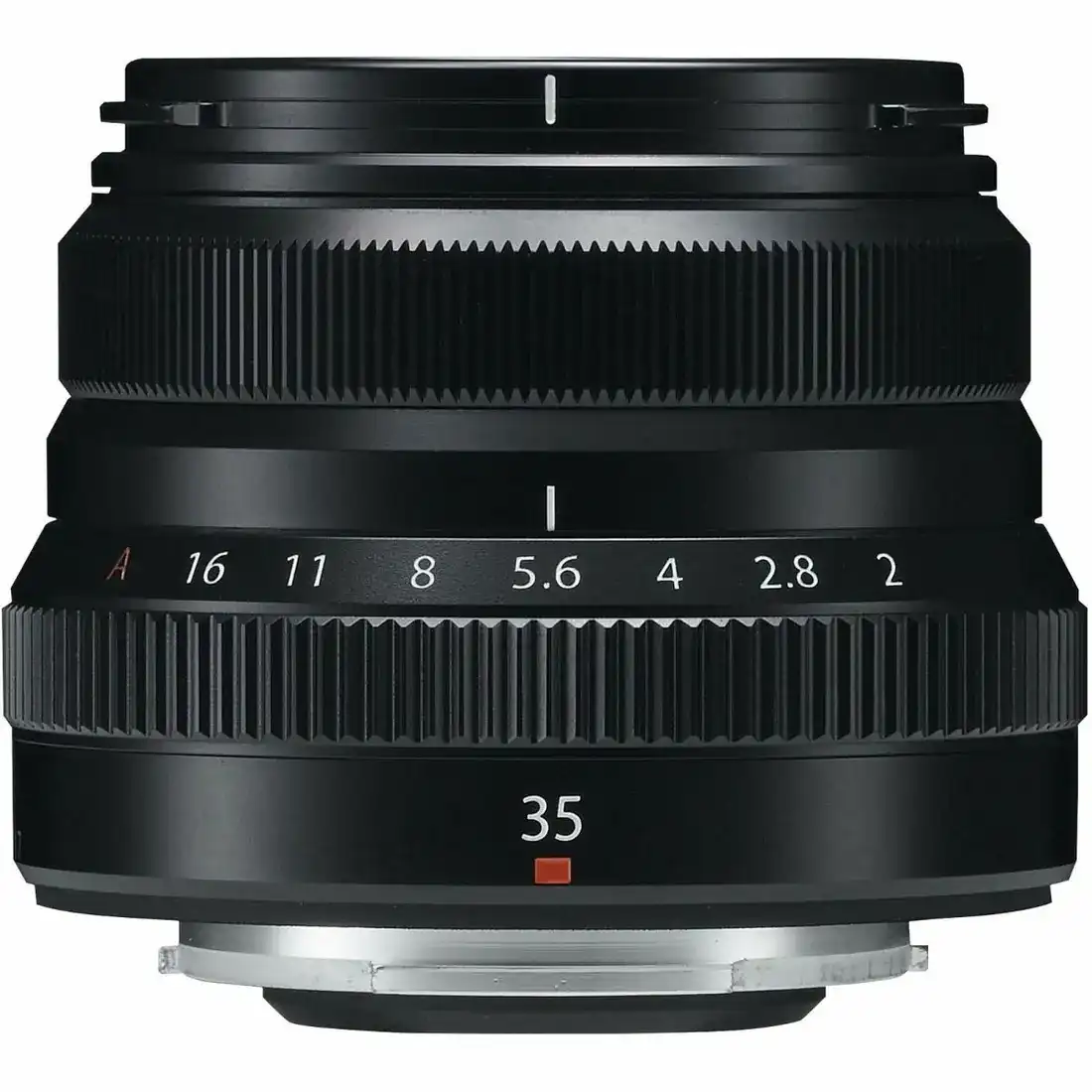
You bought a camera body, skipped the kit lens, and now face a wall of confusing lens names. The good news: you do not need the most expensive lens to make excellent photographs. You need one that fits your camera, your subjects, and the way you actually shoot.
The first question is not “Which lens is sharpest?” It is “Will this lens work on my camera?” Sony E, Canon RF, Nikon Z, and Fujifilm X are different lens mounts. A lens made for one mount generally will not attach directly to another. Even within a brand, older DSLR lenses and newer mirrorless lenses can use different mounts. Some adapters work, but they add cost and complexity. For your first lens, buying a native-mount option is usually simpler.
Next, identify your camera’s sensor size. A full-frame lens may work on an APS-C camera with the same mount, but the smaller sensor crops the view. A lens designed for APS-C may not cover a full-frame sensor, or the camera may switch to a lower-resolution crop mode. Before paying, confirm the exact camera body, lens mount, sensor coverage, and autofocus compatibility on the manufacturer's product page.
Beginner rule: Write down your camera model and mount before shopping. “Canon lens” or “Nikon lens” is not a sufficient compatibility check.
2. Focal length: 35mm, 50mm, or 85mm?
Focal length controls how much of the scene fits into your frame and how large subjects appear from a given position. Shorter focal lengths capture wider scenes; longer focal lengths frame more tightly. But the numbers alone do not tell the whole story: a 50mm lens on an APS-C camera looks tighter than a 50mm lens on a full-frame camera.
35mm: everyday scenes and environmental portraits
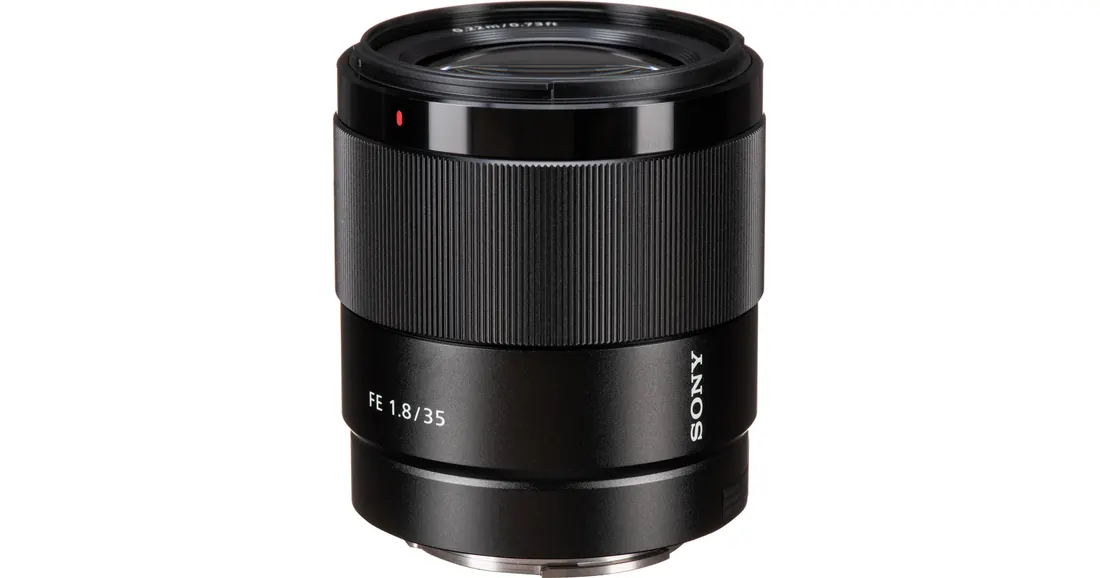
Sony FE 35mm F1.8 — a full-frame wide-normal prime lens.
On full-frame, 35mm is wide enough for street scenes, travel, food, and portraits that include a little background. It is forgiving in small rooms where you cannot step back. On APS-C, a 35mm lens gives a field of view roughly like 50–56mm on full-frame, depending on the system. That makes an APS-C 35mm lens a particularly useful general-purpose choice.
50mm: the classic all-round prime
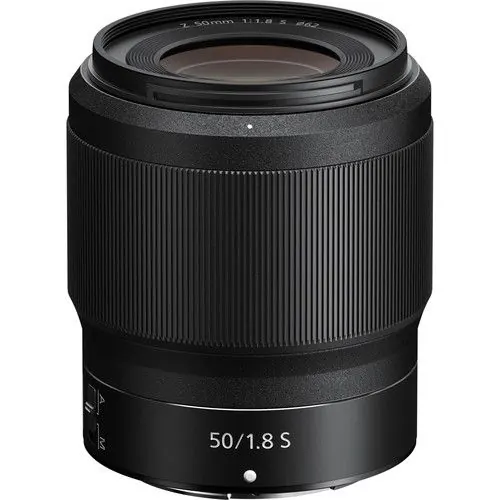
Nikon NIKKOR Z 50mm f/1.8 S — a premium 50mm prime lens.
A 50mm lens on full-frame offers a natural-looking field of view for portraits, details, everyday objects, and many indoor scenes. It encourages you to move your feet and think about composition. On Sony or Nikon APS-C, a 50mm lens behaves like approximately 75mm in framing; on Canon APS-C it is closer to 80mm. That can be wonderful for portraits but too tight for a cramped apartment.
85mm: portraits and flattering separation
An 85mm lens on full-frame is popular for head-and-shoulders portraits because you can stand farther away while keeping the subject prominent. It is less convenient for small rooms, groups, or general travel. On APS-C, it becomes even tighter. Unless portraits are your clear priority, 85mm is often a better second lens than your first.
Lens
Full-frame use
APS-C framing
Potential drawback
35mm
Street, travel, daily life
About 52–56mm equivalent
Less wide on APS-C
50mm
Everyday, portraits, details
About 75–80mm equivalent
Can be tight indoors
85mm
Portraits, subject isolation
About 128–136mm equivalent
Requires more distance
These “equivalent” figures describe field of view, not a physical change in focal length or aperture. If you own an APS-C camera and want a view similar to 50mm on full-frame, look around 30–35mm rather than automatically buying a 50mm.
3. Prime vs. zoom: which is better for a first lens?
A prime lens has one fixed focal length, such as 35mm or 50mm. A zoom lens covers a range, such as 18–50mm or 24–70mm. Neither type is universally better.
Primes are often smaller, lighter, and more affordable at wide apertures. They can produce attractive background blur and work well in dim light. The trade-off is flexibility: to change framing, you usually need to move or swap lenses. Zooms let you react quickly when the subject is far away or you cannot change position. They are convenient for family outings, travel, events, and discovering which focal lengths you enjoy most.
If you have no idea what you like to photograph, a compact standard zoom is the safer first purchase. If you already love portraits, cafés, street photography, or low-light scenes, a bright prime may be more rewarding. There is no rule saying that a serious photographer must start with a prime.
4. Kit lenses are not “bad lenses”
A kit lens is simply a lens commonly bundled with a camera body, usually a modest standard zoom. Typical examples cover a range around 16–50mm or 18–45mm on APS-C. They are designed to be versatile, light, and affordable, not necessarily to offer the widest aperture.
A prime lens is not the opposite of a kit lens in quality; it is a different type of lens. You can make excellent photographs with a kit zoom, especially outdoors or in good light. A 50mm f/1.8 prime often gives you more background blur and more light than a kit zoom at the same focal length, but it loses the zoom's flexibility.
Because you bought your camera without a kit lens, think of a kit-style zoom as a perfectly valid first-lens option rather than something you need to “graduate from.” For travel and mixed subjects, it may be the most useful choice.
5. Aperture: f/1.8 vs. f/4 explained
The f-number describes the size of the lens opening relative to its focal length. A lower number means a wider maximum aperture. An f/1.8 lens can admit roughly five times as much light as an f/4 lens at the same shutter speed and ISO, because the difference is a little over two stops. That is useful for indoor portraits, evening streets, and situations where you want to avoid raising ISO too far.
Wider apertures also make it easier to blur the background, especially when your subject is close and the background is farther away. But f/1.8 is not automatically the best setting. At close portrait distances, the depth of field can be so shallow that one eye is sharp and the other is not. For groups, landscapes, and product photography, f/4, f/5.6, or f/8 may be more appropriate.
An f/4 lens can still be excellent. It may be smaller, less expensive, or offer a more useful zoom range. In bright daylight, the practical difference between f/1.8 and f/4 may matter less than framing, autofocus, and handling. Choose the aperture for your actual shooting conditions, not because the smaller number looks more impressive.
6. Do you need image stabilization?
Stabilization reduces blur caused by camera shake. Some lenses have optical stabilization, often labeled IS (Canon), VR (Nikon), or OIS (Fujifilm). Some camera bodies have in-body image stabilization, or IBIS. Certain combinations work together; others do not. Always check the exact camera-lens pairing.
Stabilization is valuable when photographing stationary subjects handheld at slower shutter speeds: museums, interiors, city scenes after sunset, and travel details. It does not freeze a moving child, running pet, or athlete. To stop subject movement, you still need a sufficiently fast shutter speed, which may require a wider aperture or higher ISO.
If your camera lacks IBIS and you expect to shoot handheld in dim environments, a stabilized zoom deserves extra consideration. If you mainly photograph people moving indoors, a bright f/1.8 prime may help more than stabilization alone. The ideal combination depends on your subjects.
7. Why the 50mm f/1.8 “nifty fifty” is so popular
The nickname nifty fifty usually refers to a relatively inexpensive 50mm lens with an f/1.8 maximum aperture. It is a classic recommendation because it gives beginners an accessible introduction to shallow depth of field, low-light photography, and deliberate composition. Compared with many basic kit zooms, it can make portraits look noticeably different without requiring a professional-level budget.
However, “best for beginners” needs a qualification. A 50mm f/1.8 is particularly appealing on full-frame cameras. On APS-C bodies, the narrower framing can feel restrictive for travel, room interiors, and group photos. For an APS-C beginner, a 30–35mm prime may be the better everyday equivalent. If you shoot everything from landscapes to family gatherings, a standard zoom may be more practical than either prime.
Think of the nifty fifty as a great value, not a universal answer. The right first lens is the one you will actually carry and use.
8. Recommended beginner lenses for Sony, Canon, Nikon, and Fujifilm
These are examples across budget levels, not a ranking of current prices. Retail availability and prices change. Amazon buttons below open searches for the named model rather than guaranteeing a specific seller or listing. Confirm the mount, sensor coverage, and exact model before buying.
Compatibility warning: A matching brand name alone does not mean a lens fits your camera. In particular, Sony FE versus APS-C E, Canon RF versus RF-S, Nikon Z versus Z DX, and Fujifilm X-mount coverage affect what you see and how the lens performs.
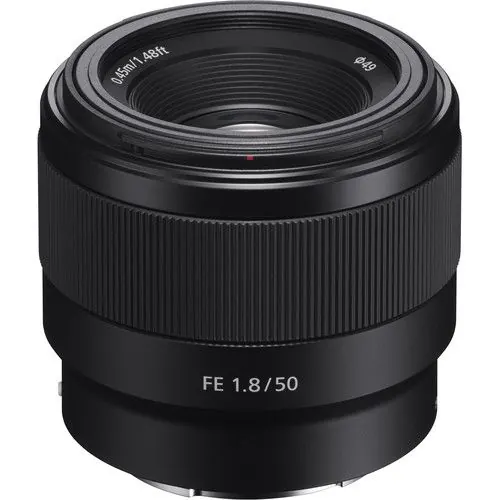
Sony FE 50mm F1.8 — an affordable full-frame prime lens.
Sony FE 50mm F1.8
Compatibility: Sony full-frame E-mount; also fits Sony APS-C E-mount · Budget: Budget prime
A compact portrait and low-light starter on full-frame Sony bodies. On APS-C it frames like roughly 75mm, which is tighter indoors.
Instead of comparing every specification, ask yourself three questions. First, what will you photograph most often? For family trips and varied subjects, choose a standard zoom. For portraits, details, and low light, consider a bright prime. For street photography, a compact 35mm-equivalent field of view is often a comfortable starting point.
Second, where will you shoot? A small apartment favors wider framing. Outdoor portraits give you room to use a longer lens. Travel favors lighter gear. If you cannot move backward to fit a group into the frame, an 85mm portrait lens will not solve the problem no matter how sharp it is.
Third, what can you comfortably spend after accounting for essentials? You may also need a memory card, a spare battery, a bag, or basic cleaning supplies. Do not spend your entire photography budget on a lens because an online review calls it “essential.” A modest lens used regularly will teach you more than a premium lens left at home.
10. Your first-lens buying checklist
Camera mount: Verify the exact mount and whether an adapter is required.
Sensor coverage: Check full-frame versus APS-C compatibility.
Field of view: Consider crop factor before choosing 35mm, 50mm, or 85mm.
Subjects: Match the focal length to portraits, travel, street scenes, or family photography.
Aperture: Choose f/1.8 for more low-light flexibility and blur; do not dismiss f/4 for daylight and general use.
Stabilization: Check whether your body or lens has it, and remember it does not stop subject motion.
Autofocus: Confirm autofocus works on your specific body, especially with third-party lenses.
Weight and size: A lens that fits your bag is more likely to come with you.
Used purchases: Inspect glass, mount, autofocus, zoom/focus rings, and return policy.
Price: Compare current listings and verify the exact lens variant before ordering.
11. Common mistakes to avoid
Buying only by maximum aperture. A fast f/1.8 lens is useful, but not if its focal length makes your usual subjects impossible to frame. Ignoring crop factor. A 50mm on APS-C is not the same everyday experience as 50mm on full-frame. Assuming stabilization fixes motion blur. It helps with your hands, not a moving subject. Choosing a lens by brand alone. Mounts and formats matter. Buying too many lenses immediately. Spend several weeks with one lens before deciding what you truly lack.
One helpful exercise is to photograph the same subject from different distances and angles for a week. Notice when you want a wider view, a tighter portrait, more light, or less weight. Those frustrations are useful clues. They will tell you what your second lens should be far more reliably than a generic “top ten” list.
Final recommendation: choose for your life, not the spec sheet
For a first lens without a kit zoom, a compact standard zoom is the most flexible choice if you shoot many subjects. A bright prime around a 50mm-equivalent field of view is a strong alternative if you value low-light shooting, portraits, and learning composition. On full-frame, that often means a 50mm f/1.8; on APS-C, it often means something closer to 30–35mm. Save an 85mm lens for when you know portraits are your priority.
Above all, confirm compatibility, stay within your budget, and start taking photographs. Your experience with the lens will matter more than a few points on a comparison chart.
Affiliate Disclosure
As an Amazon Associate I earn from qualifying purchases. Some links on this page are affiliate links, which means PhotoMasterHQ may earn a commission if you make a qualifying purchase, at no additional cost to you. Our educational recommendations are based on practical photographic needs rather than commissions.